Lesson 12 把英文裡幾個最容易讓中文母語者卡關的進階文法主題一次整理:何時用動名詞、何時用不定詞;usually、used to、be used to、get used to 這四個長得像卻意思完全不同的用法;用 wish 表達遺憾的時態變化;rather 的偏好句型;連接詞、關係子句、主動/被動語態,以及間接引述。每個主題都搭配一張漫畫場景,把規則放進真實對話裡。
這一課的重點不是背更多單字,而是把「結構」搞清楚。建議邊看書中的句型公式,邊把例句寫下來自己換主詞、換動詞造句。
動名詞還是不定詞(Gerund or To + Infinitive)#
英文動詞後面要接 -ing(動名詞)還是 to + 原形(不定詞)?這頁用一張圖把規則整理成兩欄。
用動名詞(GERUND)的時機
- 介系詞之後 — I’m tired of running.(我跑累了。)
- 某些動詞後:like, love, hate, enjoy, mind, finish, stop — I enjoy seeing you.(我喜歡見到你。)
- 當作句子的主詞 — Smoking is a pleasure.(抽菸是一種享受。)
用不定詞(TO + INFINITIVE)的時機
- 形容詞之後 — This problem is difficult to solve.(這問題很難解決。)
- 某些動詞後:would like, want, need, decide, hope, expect, plan, forget, seem, try, promise, offer, refuse, learn, manage — I would like to escape.(我想逃走。)
- 表達目的或原因 — I’m chasing this guy to earn my bread and butter.(我追這傢伙是為了糊口飯吃。)
書中用一張漫畫把規則濃縮成兩句台詞:警察追小偷時喊 Stop! I’m tired of running.(用 of 後接動名詞);小偷則回 This is a difficult situation to solve. I enjoy seeing you tired, but I would also like to escape.(一句話裡同時出現「形容詞 + to V」「enjoy + V-ing」「would like + to V」三種用法。)
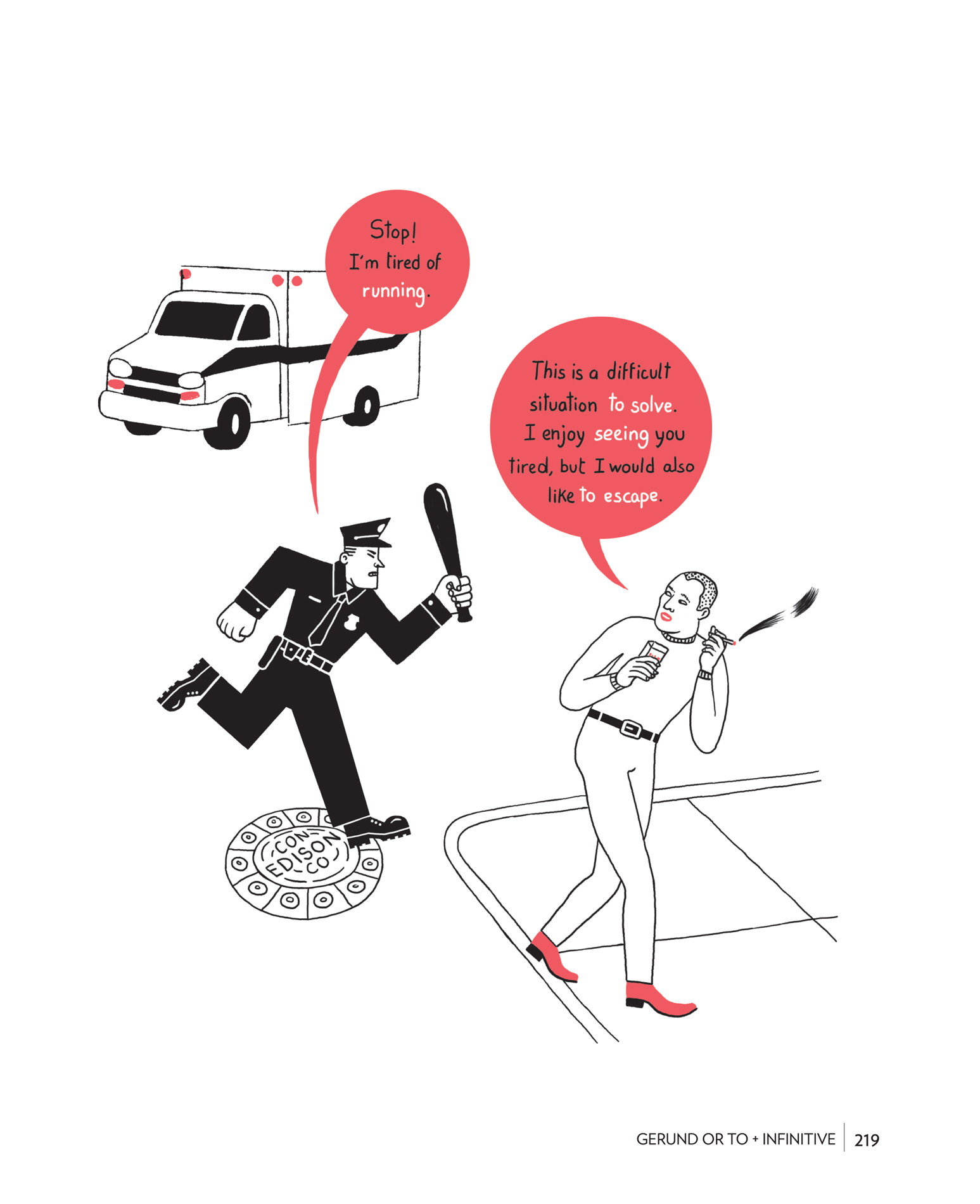
Figure 12.1: 警察追小偷的漫畫,把動名詞與不定詞的用法寫進對話
Usually、Used To、Be Used To、Get Used To#
這四個用法長得像,但意思天差地遠。書中用一位英文老師 Melissa 和學生 Meritxell 的故事把它們連起來。
USUALLY — 表達現在的習慣
- 句型:subject + USUALLY + verb
- Melissa, a good English teacher, usually makes students repeat sentences correctly.(Melissa 是個好英文老師,她通常會要學生把句子正確地複誦一遍。)
- This usually bothers Meritxell, her student, a little.(這通常讓她的學生 Meritxell 有點煩。)
USED TO — 表達過去的習慣或已改變的狀態
- 句型:subject + USED TO + infinitive
- Meritxell used to take drugs, but now she doesn’t even smoke.(Meritxell 以前會嗑藥,但現在她連菸都不抽。)
BE USED TO — 表達已經習慣了的新狀態
- 句型:subject + BE USED TO + gerund or noun
- Melissa is used to craving food all the time since she gave up smoking.(Melissa 戒菸後已經習慣整天嘴饞。)
GET USED TO — 表達正在習慣、慢慢適應某件事
- 句型:subject + GET USED TO + gerund or noun
- Melissa and Meritxell haven’t got used to living without addictions.(Melissa 和 Meritxell 還沒習慣沒有上癮物的生活。)
三個 used to 的關鍵差別:
- used to + 原形:以前的習慣(現在不做了)
- be used to + V-ing/名詞:現在已經習慣了
- get used to + V-ing/名詞:正在從不習慣變習慣
中文都翻成「習慣」,但時間點完全不同。
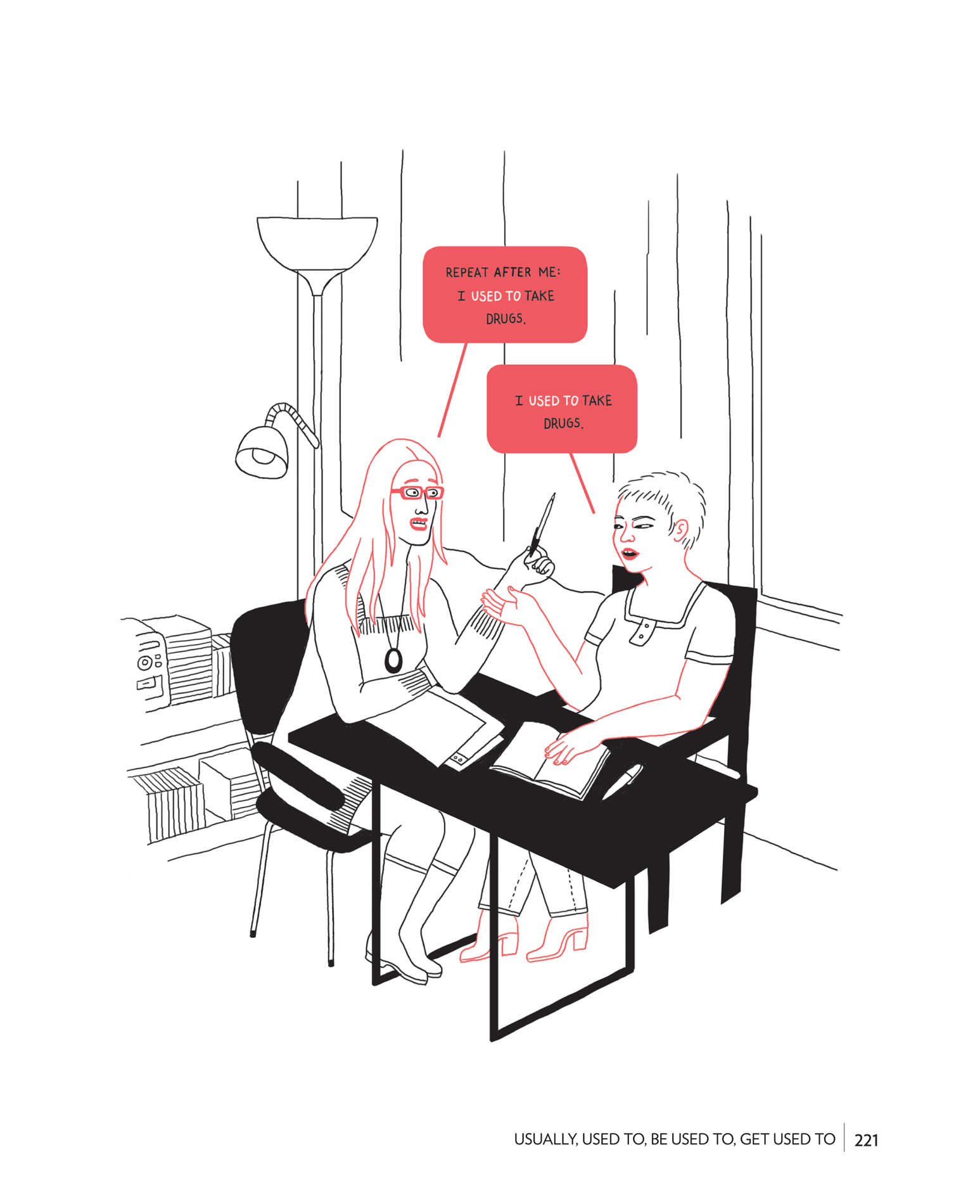
Figure 12.2: 英文老師 Melissa 與學生 Meritxell 的場景:Repeat after me — I used to take drugs.
願望(Wish)#
WISH 用來表達「遺憾」或「對不真實情況的想像」。書中用一個冷天裡獨坐紐約街頭的男生說 I wish you were here.(要是你在這裡就好了。)做開場。時態是區分這幾種 wish 的關鍵。
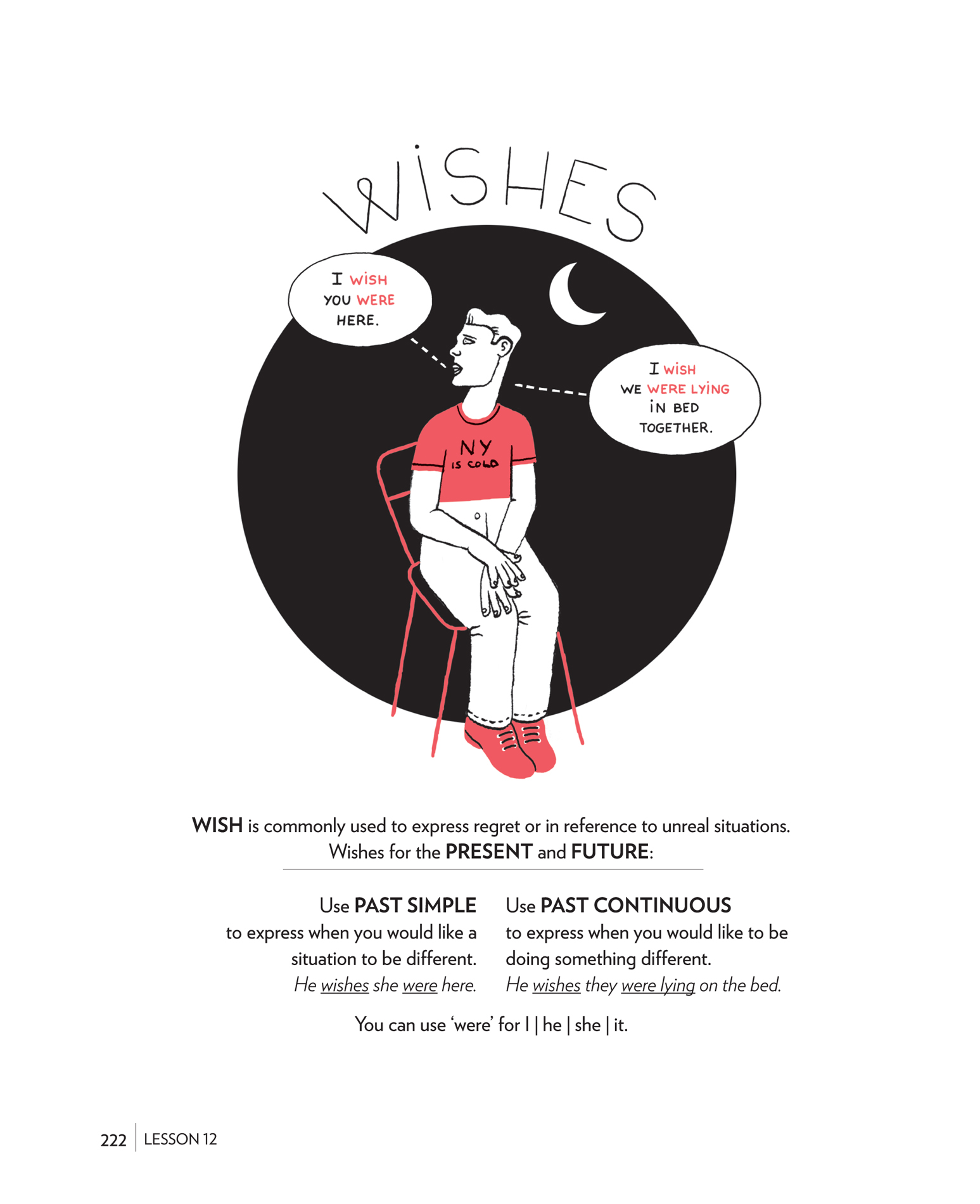
Figure 12.3: 紐約寒夜,男生在月光下獨坐 — I wish you were here.
對現在或未來的願望
- 想要「現在的狀態」不一樣 → 用過去簡單式(PAST SIMPLE)
- He wishes she were here.(他希望她在這裡。)
- 想要「現在正在做的事」不一樣 → 用過去進行式(PAST CONTINUOUS)
- He wishes they were lying on the bed.(他希望他們此刻正躺在床上。)
在 wish 句型中,I/he/she/it 後面也可以用
were(不是 was),這是虛擬語氣的固定用法。
對過去的願望(後悔)
- 用過去完成式(PAST PERFECT)表達遺憾或希望過去不一樣
- He wishes she hadn’t come over.(他希望她當初沒過來。)
抱怨或表達不耐
- 用
WOULD + VERB— He wishes she would stop laughing.(他真希望她別再笑了。) - 用
COULD + VERB— He wishes he could make her disappear.(他真希望能讓她消失。)
SUBJECT + WISH + PRONOUN也用在固定的祝福語:I wish you the best.(祝你一切順利。)
Rather#
RATHER 用來表達「偏好」。書中用幾個美術館裡的場景把不同句型示範一次。
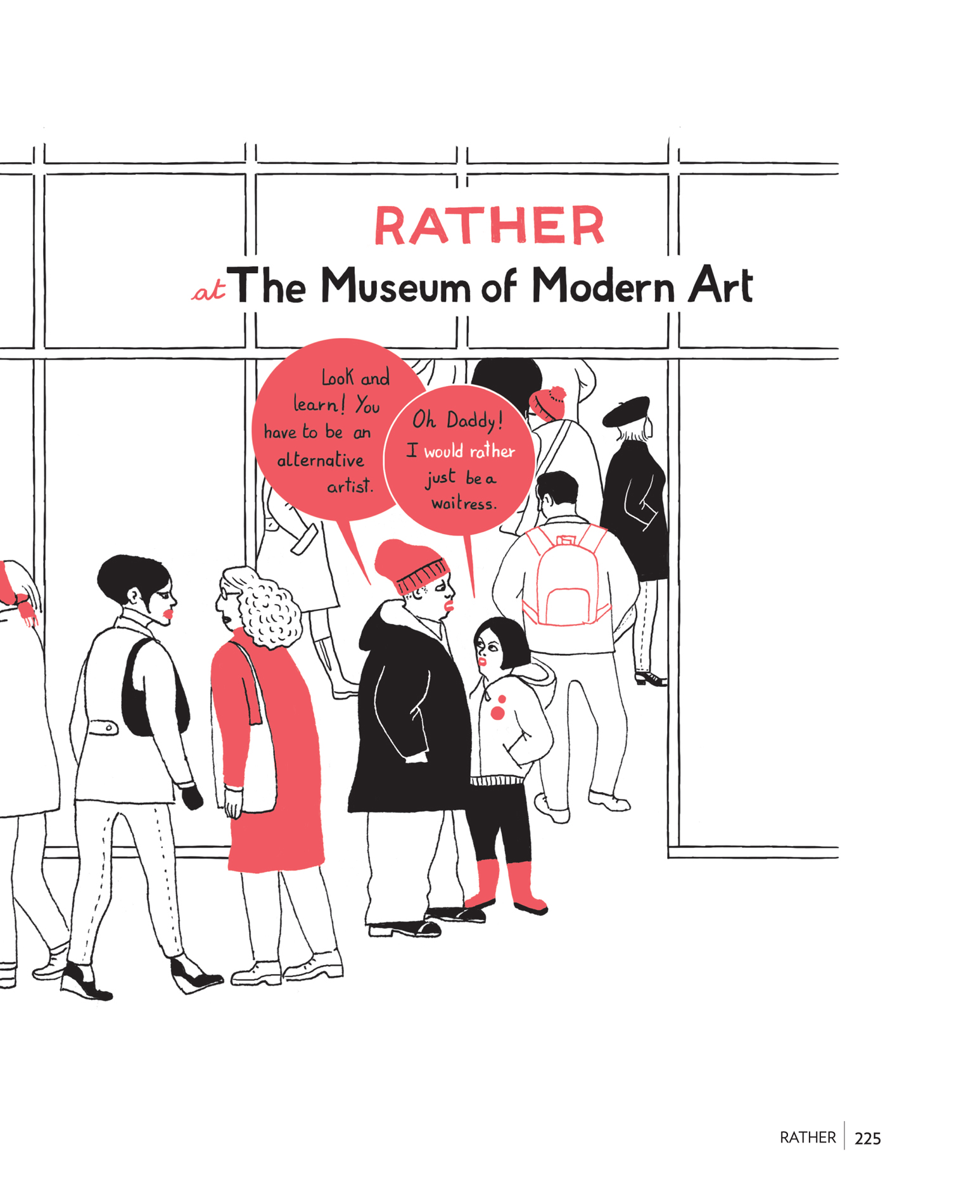
Figure 12.4: 現代美術館門口排隊,小女孩說 — Oh Daddy! I would rather just be a waitress.
RATHER THAN — 「而不是」、「並非」
- 用來比較兩個平行結構。
- He is a sex maniac rather than an art enthusiast.(他是個色情狂,而不是藝術愛好者。)
WOULD RATHER … THAN — 「寧願…也不要…」
- 句型:SUBJECT + WOULD RATHER + INFINITIVE without ’to’ + OPTION 1 + THAN + OPTION 2
- Elvis would rather be the centre of attention than be just like everybody else.(Elvis 寧願成為眾人焦點,也不要跟大家一樣。)
- I would rather shoot myself than queue up with all these snobs.(我寧願一槍斃了自己,也不要跟這些勢利鬼一起排隊。)
WOULD RATHER(單獨使用)— 「寧願…」
- 用來表達在某情境中偏好某個選項。
- 句型:SUBJECT + WOULD RATHER + INFINITIVE without ’to’ + OPTION
- — Hey, Jeff! Let’s get out of here! — I’d rather stay here.(嘿 Jeff,我們走吧!——我寧願留在這。)
OR RATHER — 「或者該說」
- 用來修正前面剛說的話。
- She is distracted, or rather, she is pretending to be distracted.(她心不在焉——或者該說,她是裝作心不在焉。)
RATHER(程度副詞)— 「相當地」
- 意思接近 quite。
- Marilyn had a rather tender look.(瑪麗蓮有種相當溫柔的神情。)
書中還收了一句小女孩的台詞:Oh Daddy! I would rather just be a waitress.(爸,我寧願去當服務生就好。)小女孩拒絕爸爸要她當「另類藝術家」的期待,把 would rather 用在生活的對話裡。
連接詞(Connectors)#
連接詞(也叫 linking words 或 linkers)負責把句子和句子之間的關係表達清楚。書中先用一段 Harry 與 Elisabeth 的偵探小故事,把多種連接詞紅字標出來示範:The weather was very bad and, in addition, the car lights didn’t work because they had been shot out… Despite all this, Harry managed to get to the place… so Harry carefully crawled through the bushes… Suddenly, a shiver came over his body. Instead of crying, Elisabeth was actually laughing and looking directly into Harry’s eyes while holding the gun.
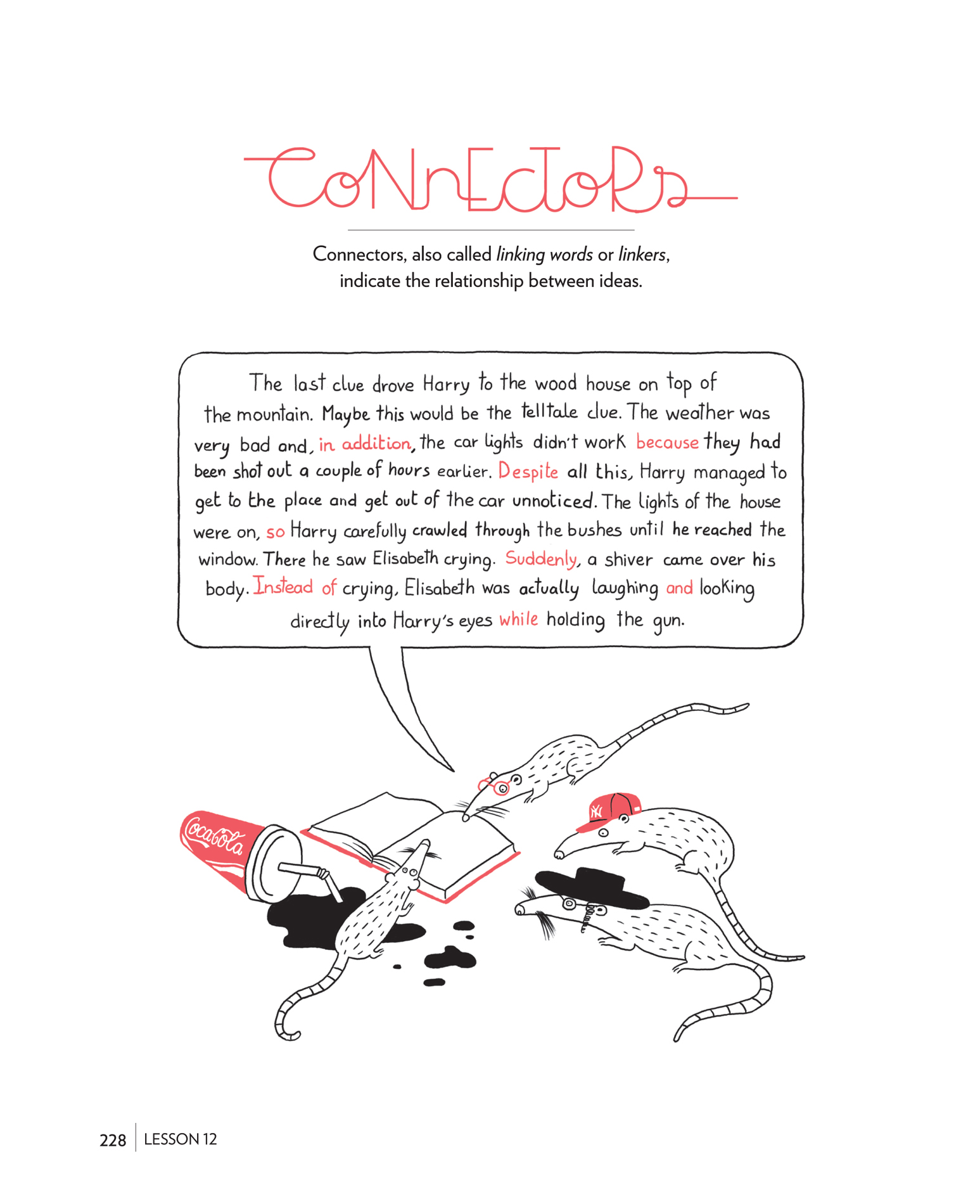
Figure 12.5: Harry 與 Elisabeth 的偵探故事,連接詞用紅字標示出句子之間的邏輯關係
接著按「意義」把連接詞分類:
- 舉例(GIVING EXAMPLES):for example (e.g.), for instance, such as
- 引入主題(INTRODUCING A TOPIC):with regard to, regarding, concerning, by the way
- 追加資訊(ADDING INFORMATION):and, also, too, as well as, in addition, apart from, besides, furthermore, moreover, then again
- 總結(SUMMARISING):in short, in brief, in summary, to conclude, in conclusion
- 說明原因(GIVING A REASON):because, because of, for, since, as, due to, owing to
- 引出結果或發展(INTRODUCING DEVELOPMENTS):so, consequently, as a result, therefore, thus, hence
- 表達對比(REFLECTING CONTRAST):but, however, although, even though, though, despite, in spite of, nevertheless, nonetheless, while, whereas, unlike, on the other hand, anyway
- 排序(SEQUENCING IDEAS):firstly, secondly, thirdly, to begin with, next, lastly, finally
- 敘事中的時間(DURING THE NARRATIVE):at the beginning, then, at last, once, afterwards, suddenly, finally, in the end
- 強調(EMPHASISING):obviously, particularly, in theory, in fact, especially
- 表達確定(SHOWING CERTAINTY):surely, indeed, undoubtedly, certainly, even so
關係子句(Relative Clauses)#
關係子句是一種「從屬子句」,用來修飾主要子句裡的某個詞、片語或概念。它的開頭是「關係代名詞」:WHO、WHOM、WHOSE、THAT、WHICH(在某些情況下,WHAT、WHEN、WHERE 也能當關係代名詞)。要用哪一個關係代名詞,取決於子句的類型。
關係子句分兩種:Defining Clauses(限定) 與 Non-Defining Clauses(非限定)。
限定子句(Defining Clauses)— 不可省
- 子句裡的資訊是「必要的」。一旦刪掉,就不知道在講誰、在講什麼。
- 用人時:WHO、THAT(接介系詞時用 WHOM)
- 用物時:WHICH、THAT
- 這類子句不用逗號分開。
- The woman who is pushing a pushchair is her heroine.(那個推著嬰兒車的女人是她心中的英雄。)
非限定子句(Non-Defining Clauses)— 可省的補充
- 子句裡的資訊是「非必要的」。即使刪掉,也還是看得出在講誰、什麼。
- 用人時:WHO(也可用 WHOM、WHOSE)
- 用物時:WHICH(也可用 WHOSE)
- 這類子句要用逗號和主要子句分開。
- Exercise, which is supposed to be good for your health, is killing her.(運動本來應該對健康有益,卻把她累得半死。)
- The press, which is threatened by rapidly changing technology, is making a daily effort to keep its readers’ interest.(新聞業在科技急速變化下飽受威脅,每天都在努力留住讀者的興趣。)
判斷哪一種:把關係子句拿掉。如果整句話還是清楚 → 非限定(要逗號);如果變得不知道在講誰 → 限定(不能用逗號)。
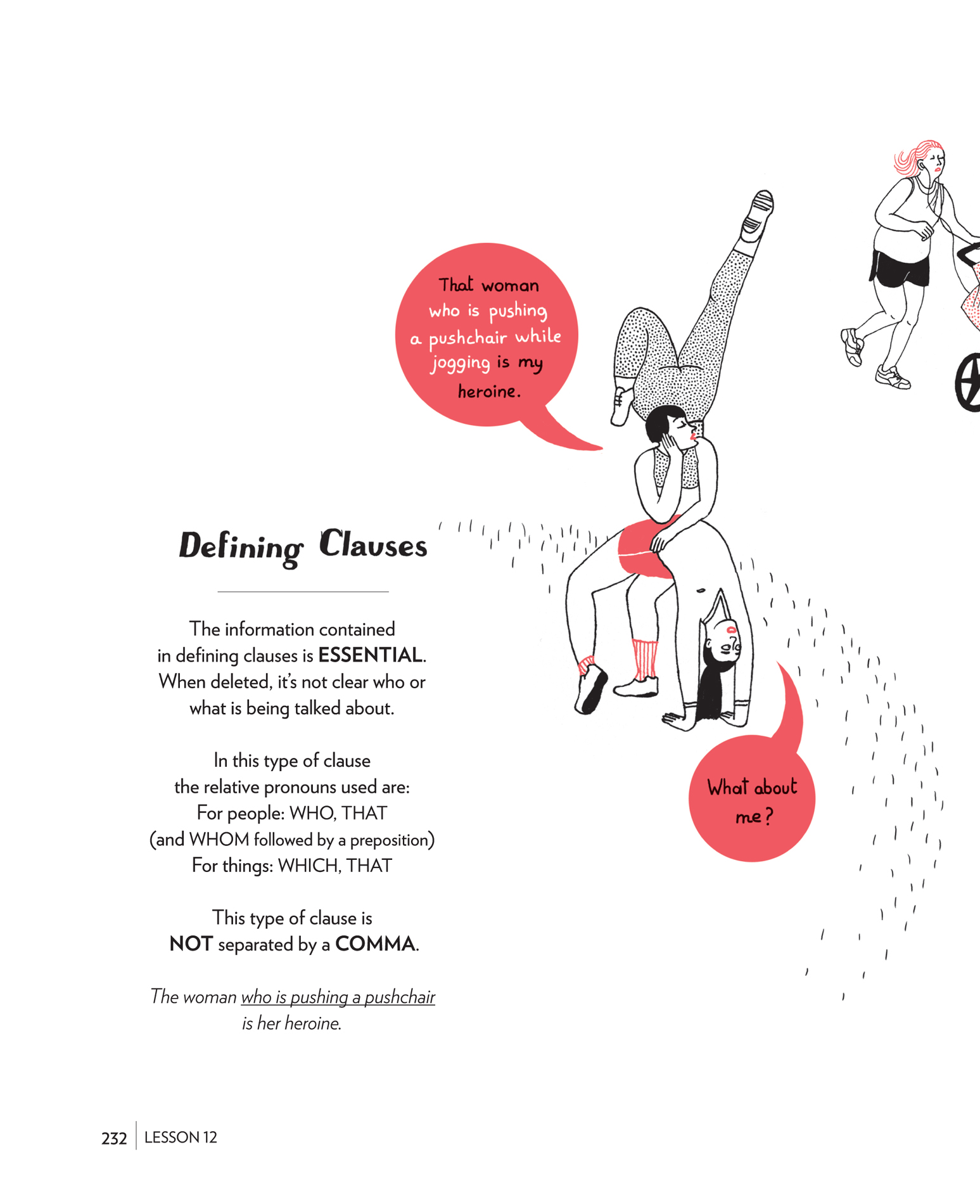
Figure 12.6: 限定子句範例 — That woman who is pushing a pushchair while jogging is my heroine.
主動與被動語態(Active and Passive Voices)#
英文有兩種語態:主動(active)與被動(passive)。
主動語態(ACTIVE VOICE)
- 描述「主詞做了什麼」。
- The dog bit Julianne’s leg.(那隻狗咬了 Julianne 的腿。)
被動語態(PASSIVE VOICE)
- 描述「主詞被怎麼了」。通常用在我們不知道、或不在意是誰做了那個動作的時候。
- Julianne’s leg was bitten by some dog.(Julianne 的腿被某隻狗咬了。)
被動的構成
- 公式 1:
TO BE + PAST PARTICIPLE— is made … - 公式 2:
TO GET + PAST PARTICIPLE— got broken …
所有時態都能變被動
- The concert will be performed next week.(這場音樂會下週將會舉行。)
- The concert has been performed already.(這場音樂會已經舉行過了。)
用 BY 帶出動作的執行者
- The painting was made by a monkey.(這幅畫是猴子畫的。)
書中用一張漫畫示範主動/被動:兩隻鴿子搶食一條蟲,主動句是 THE PIGEONS ARE EATING A WORM.;下面再寫一句被動的概括 WORMS ARE EATEN EVERY DAY ALL OVER THE WORLD.(蟲每天都在世界各地被吃。)一隻鴿子心裡還想著 I would like him to be eaten too.——把另一隻同伴也吃掉,也是被動句。
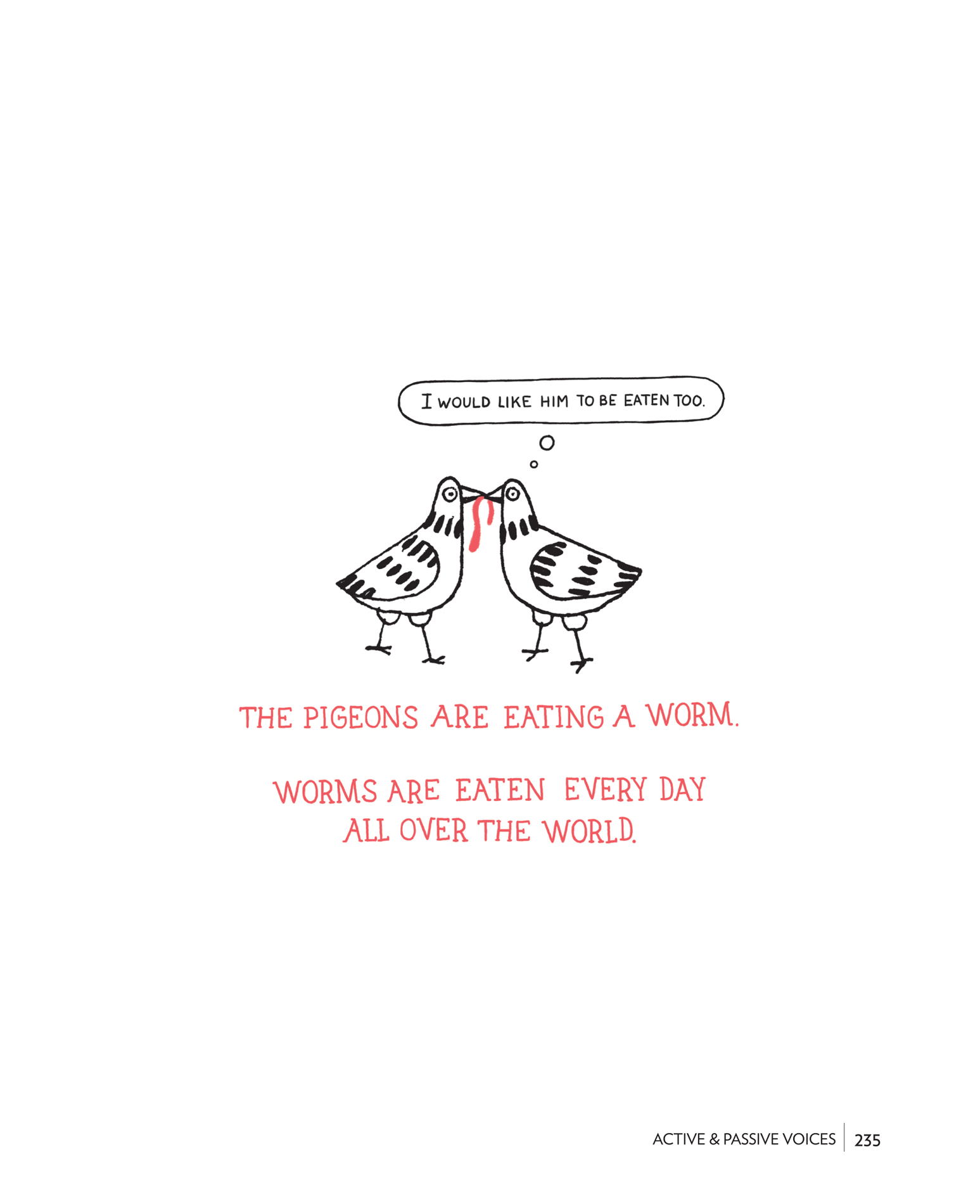
Figure 12.7: 兩隻鴿子搶食一條蟲,把主動/被動語態用漫畫一次示範
間接引述(Reported Speech)#
要轉述別人說的話有兩種方式:直接引述(DIRECT SPEECH) 與 間接引述(REPORTED SPEECH)。
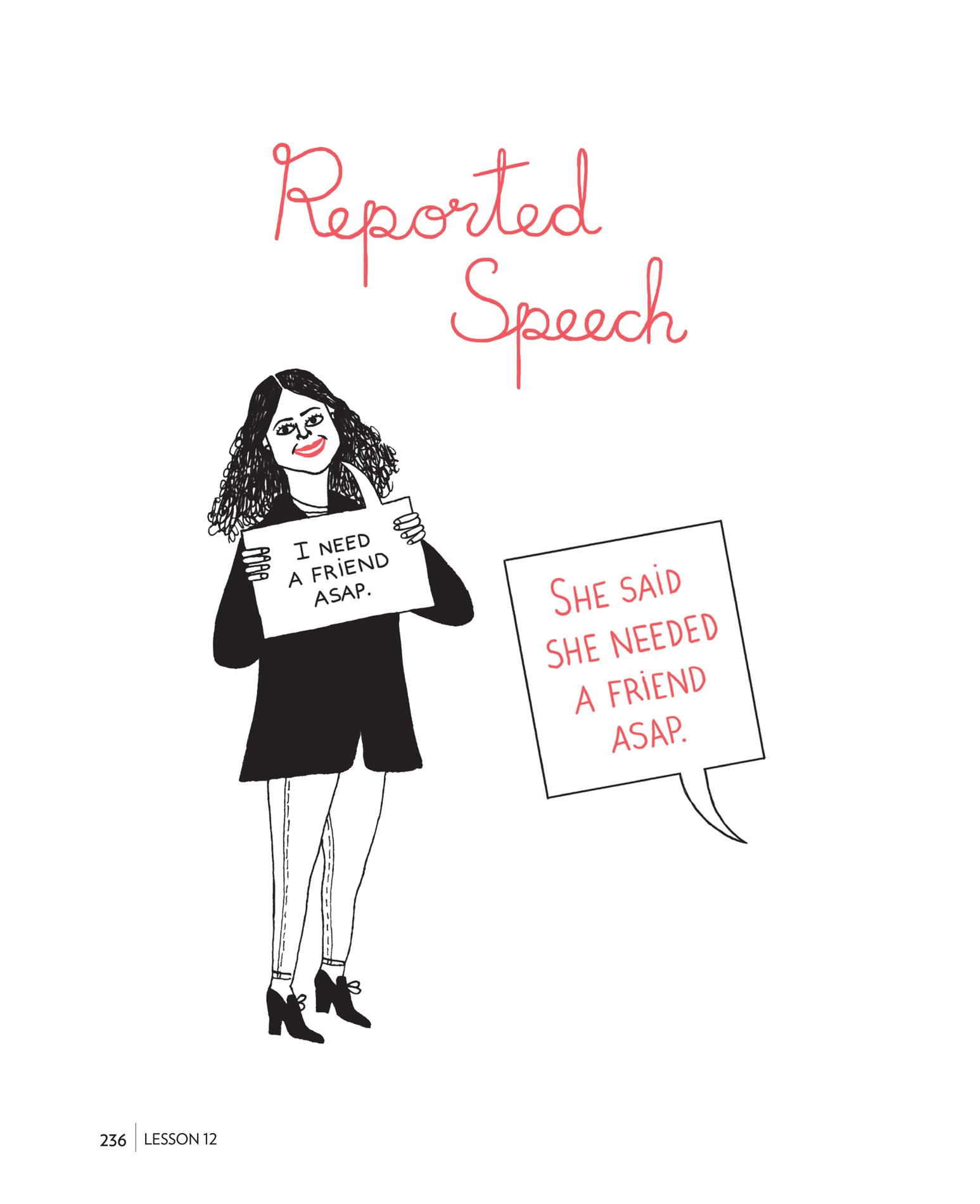
Figure 12.8: 女子手舉牌寫 I NEED A FRIEND ASAP,旁邊轉述為 SHE SAID SHE NEEDED A FRIEND ASAP.
直接引述(DIRECT SPEECH)
- 把對方原話放進引號裡,一字不改。
- She said, ‘I need a friend.’(她說:「我需要一個朋友。」)
間接引述(REPORTED SPEECH)
- 不用引號,把對方的話「轉述」出來。
- She said she needed a friend.(她說她需要一個朋友。)
核心規則:時態往後退一步
間接引述會用「直接引述的過去式版本」。常見對應:
- ‘I need a friend.’ → She said she needed a friend.(現在式 → 過去式)
- ‘I’m feeling alone.’ → She said she was feeling alone.(現在進行 → 過去進行)
- ‘I’ve spent all Sunday watching TV.’ → She said she had spent all Sunday watching TV.(現在完成 → 過去完成)
- ‘I will go to bed early.’ → She said she would go to bed early.(will → would)
例外:直接引述本身就是過去式時,間接引述不變
- ‘I was afraid.’ → She said she was afraid.
- ‘I was looking for a better life.’ → She said she was looking for a better life.
間接引述的口訣:把直接引述的時態「往過去推一格」。現在 → 過去;過去 → 過去完成;will → would;can → could;may → might。已經是過去式的不再退(過去簡單可保留,也可改成過去完成)。