Lesson 5 把英文「過去式」一次講完。從 be 動詞的 was/were 開始,接著是規則動詞加 ED 的拼字規則、否定句與問句的 did/didn’t 結構,最後用一份超長的不規則動詞總表收尾,還穿插插畫式例句幫助記憶。
過去式是英文最常用的時態之一,重點有兩個:be 動詞要分 was/were,一般動詞則分「規則」(加 ED)和「不規則」(要背)。
be 動詞的過去式(‘To Be’ in the Simple Past)#
書中用一頁把 be 動詞的過去式三個面向(肯定、否定、疑問)一次列齊。
肯定句(Simple Past Form of TO BE)
- I was
- You were
- He was
- She was
- It was
- We were
- You were
- They were
否定句(NEGATIVES):在動詞後加 not,可縮寫成 wasn’t / weren’t。
- I was not | I wasn’t
- You were not | You weren’t
- He was not | He wasn’t
- She was not | She wasn’t
- It was not | It wasn’t
- We were not | We weren’t
- You were not | You weren’t
- They were not | They weren’t
疑問句(QUESTIONS):把主詞和動詞倒裝。
- Was I . . . ?
- Were you . . . ?
- Was he . . . ?
- Was she . . . ?
- Was it . . . ?
- Were we . . . ?
- Were you . . . ?
- Were they . . . ?
書中插畫是一位戴老花眼鏡的老婆婆從電視機裡探頭,得意地說:I was on the Titanic, but not with Leonardo DiCaprio. Damn it!(我當年也在鐵達尼號上,可惜不是和李奧納多一起。可惡!)。
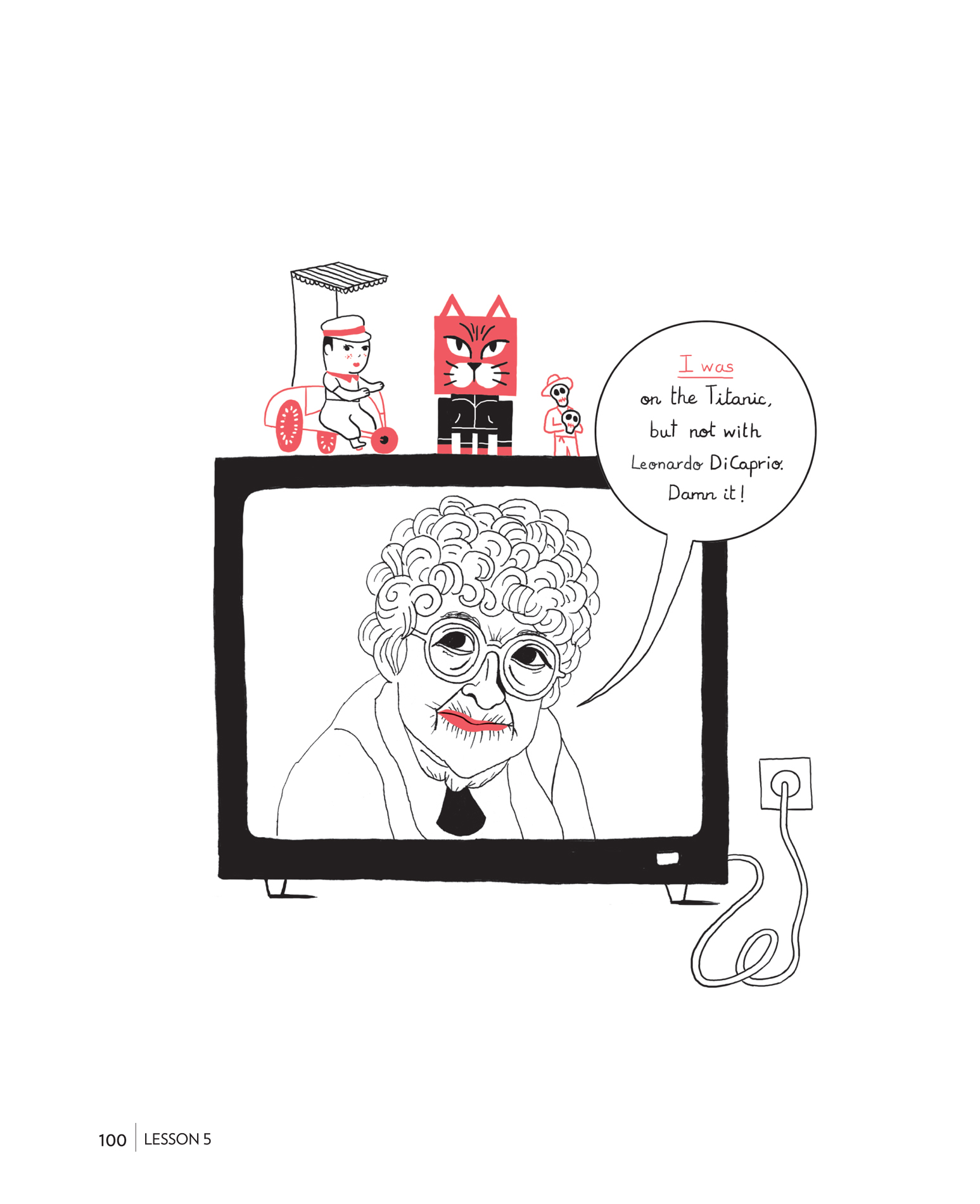
Figure 5.1: 老婆婆說 I was on the Titanic
簡單過去式(Simple Past)#
簡單過去式的基本結構就是 SUBJECT + PAST FORM,例如 She lived . . .
書中用一位坐在高腳凳上、旁邊擺著助行器的老歌手作為主視覺,旁白寫道:
She was young. She loved a man. She dreamed. She lived through terrible and wonderful things. She sang. And she still does! (她曾經年輕。她愛過一個男人。她曾經作夢。她經歷過糟糕的事與美好的事。她唱過歌。而且她現在還在唱!)
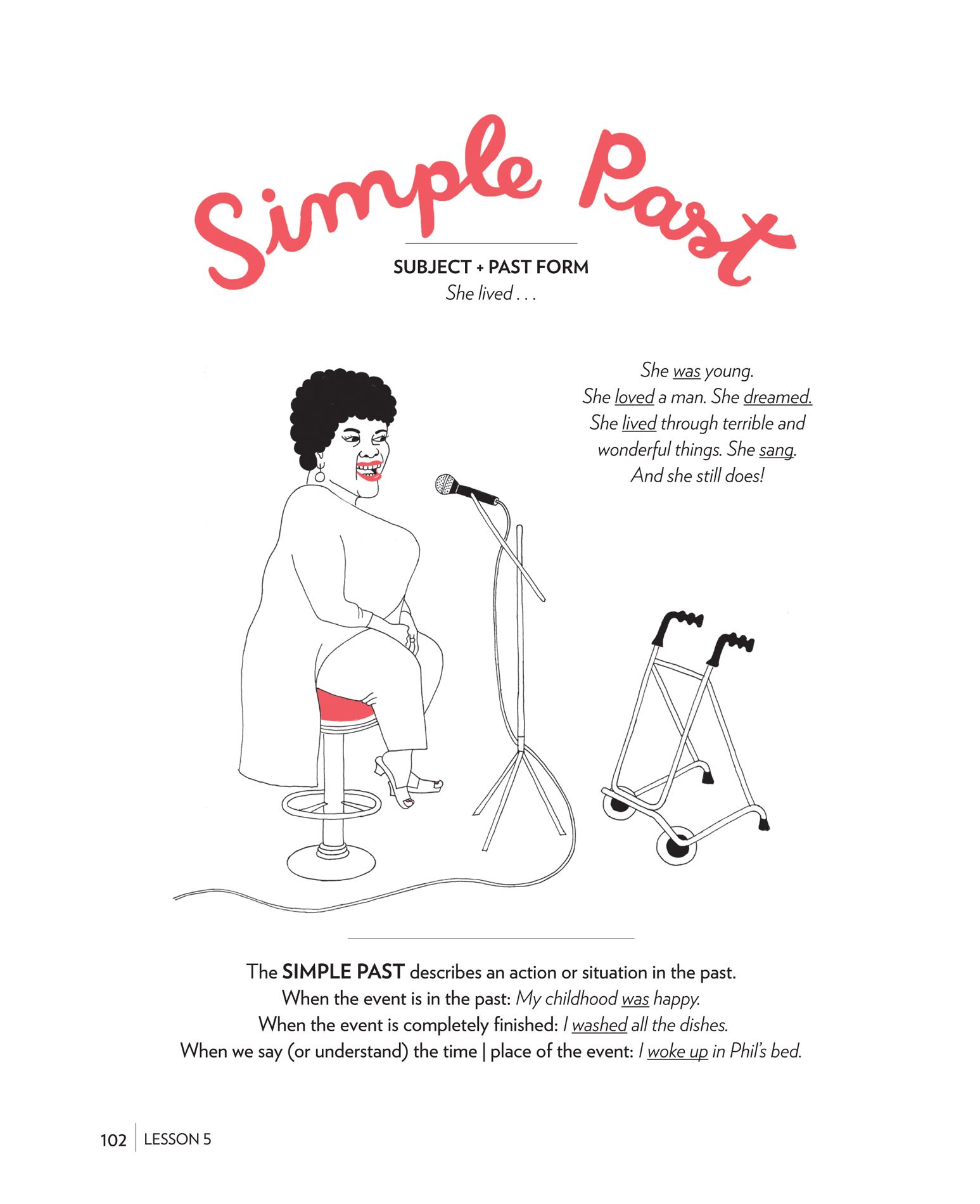
Figure 5.2: Simple Past 老歌手主視覺
SIMPLE PAST 的使用時機
- 動作或狀態發生在過去:My childhood was happy.(我的童年很快樂。)
- 動作已經完全結束:I washed all the dishes.(我把所有碗盤都洗了。)
- 有明確(或可理解)的時間/地點:I woke up in Phil’s bed.(我在 Phil 的床上醒來。)
書中其他過去式趣味例句
- I hula danced.(我跳過草裙舞。)
- I had a dozen lovers in a month.(我一個月有過十二個情人。)
- I lived the glam life.(我過過奢華光鮮的生活。)
- I managed to eat 51 boiled eggs.(我曾一口氣吃下五十一顆水煮蛋。)
- I robbed a bank.(我搶過銀行。)
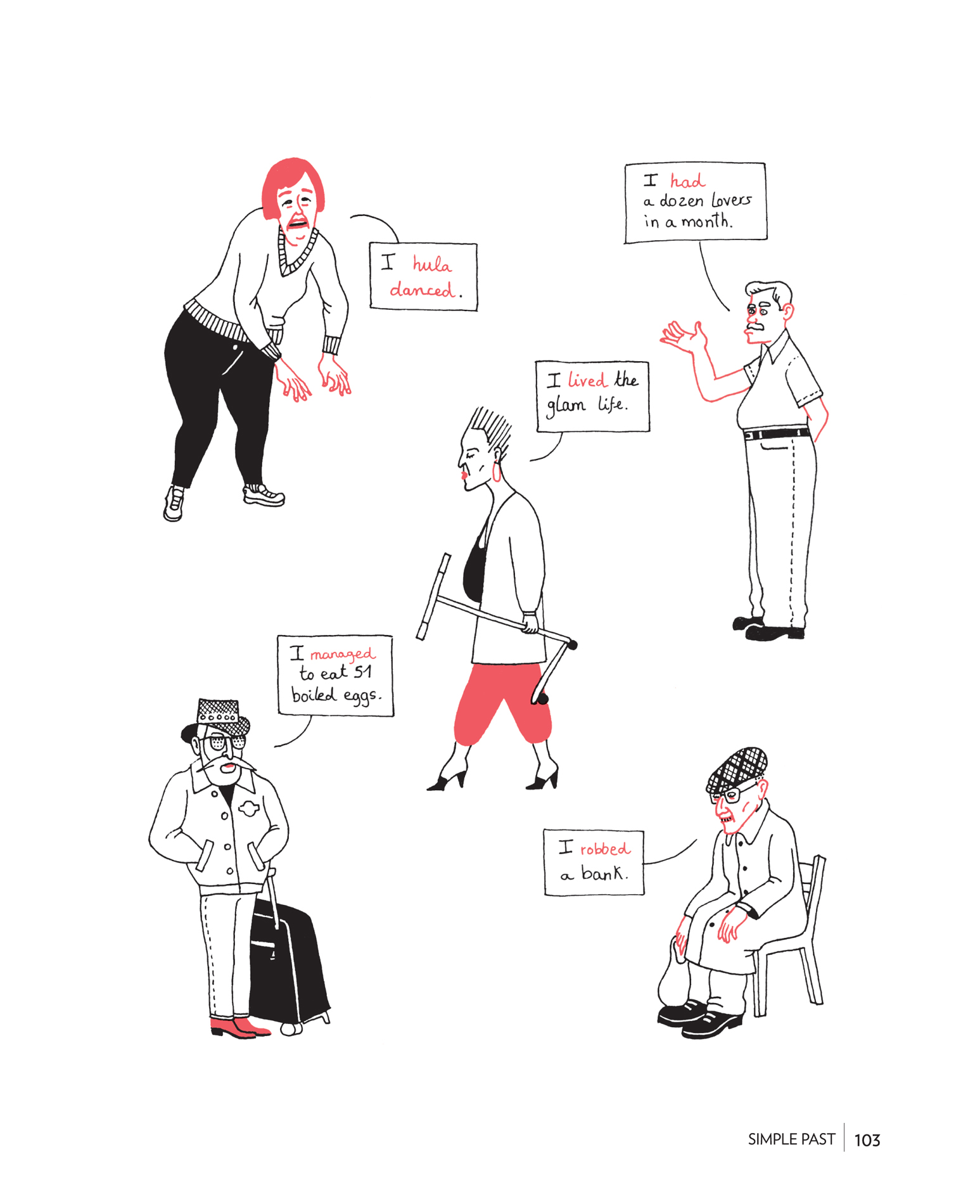
Figure 5.3: 五則過去式人物例句插畫
規則動詞如何變過去式(Forming the Simple Past Tense)#
With regular verbs, the Simple Past is created simply by adding ED, but with some verbs it is a little different. (規則動詞的過去式只要加 ED 就好,但有些動詞拼法會稍微變化。)
書中把拼字規則整理成四條:
- 字尾是 E:直接加 D。例:live → lived
- 字尾是「子音 + Y」:把 Y 改成 I 再加 ED。例:cry → cried
- 字尾是「一個母音 + 一個子音」(W、Y 除外):重複該子音再加 ED。例:commit → committed
- 其他情況:直接加 ED。例:jump → jumped
整體公式可以記成:VERB + ED。
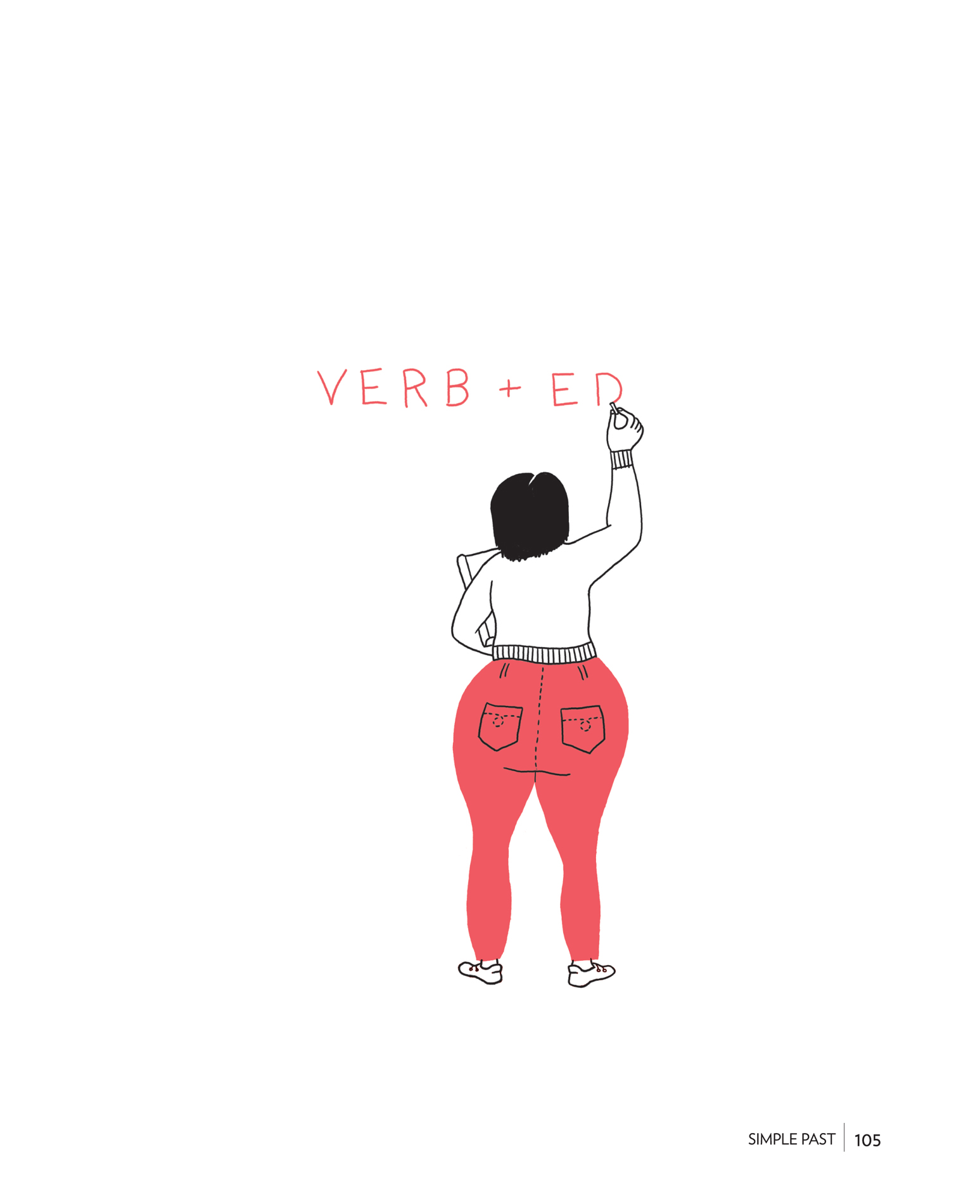
Figure 5.4: VERB + ED 公式視覺
否定句(Negative)#
SUBJECT + DID NOT | DIDN’T + INFINITIVE without ’to’ (主詞 + did not/didn’t + 原形動詞)
- DID + NOT = DIDN’T
- 例句:I didn’t go to school today.(我今天沒去上學。)
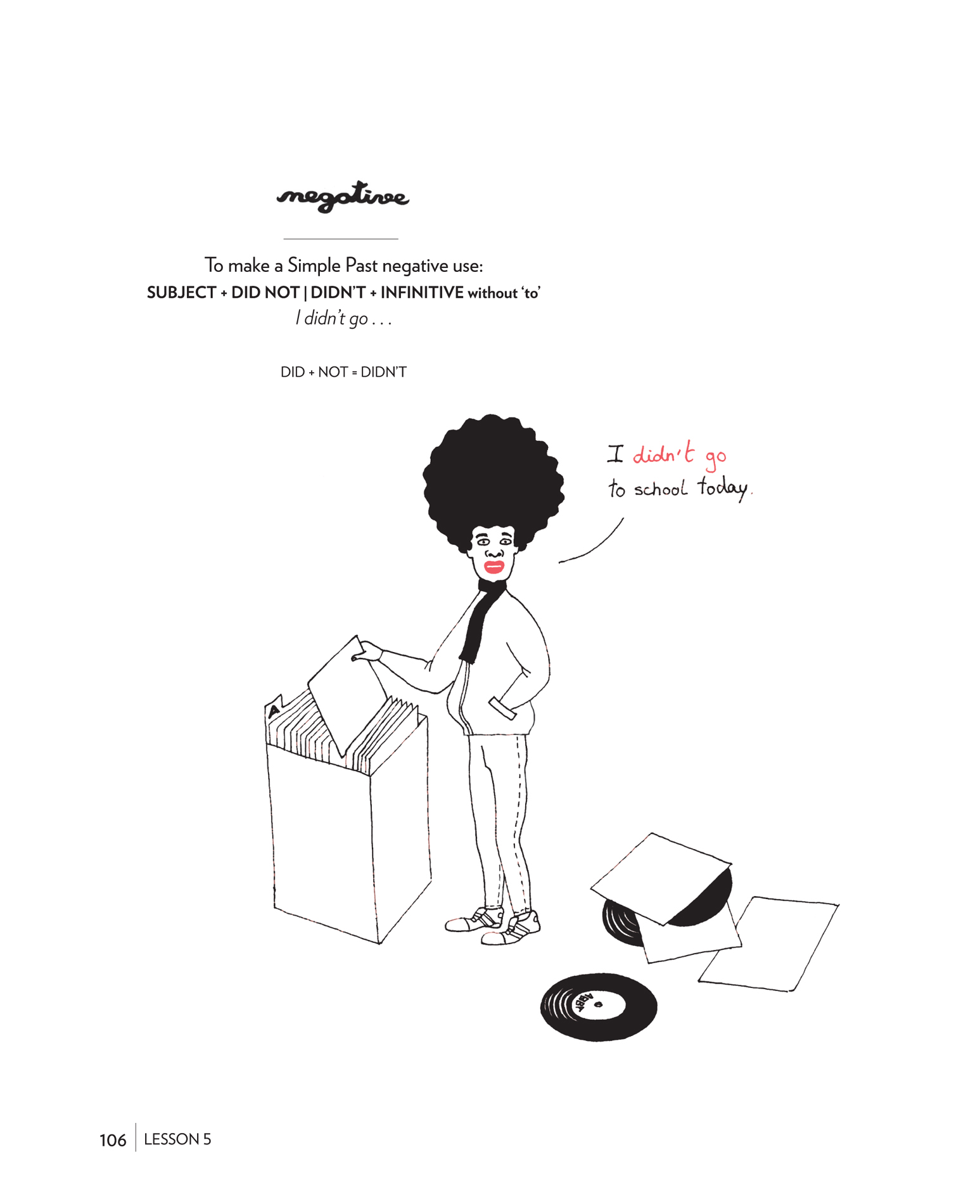
Figure 5.5: I didn't go to school today
問句(Question)#
DID + SUBJECT + INFINITIVE without ’to' (did + 主詞 + 原形動詞)
- 例句:Did you love her?(你愛過她嗎?)
書中還畫了一場紐約街頭的小劇場:男生在 Houston 街口問女生 DID YOU LOVE ME?(你愛過我嗎?),女生跑向另一台 NYC TAXI 同時冷冷回了 I NEVER DID.(我從沒愛過。)
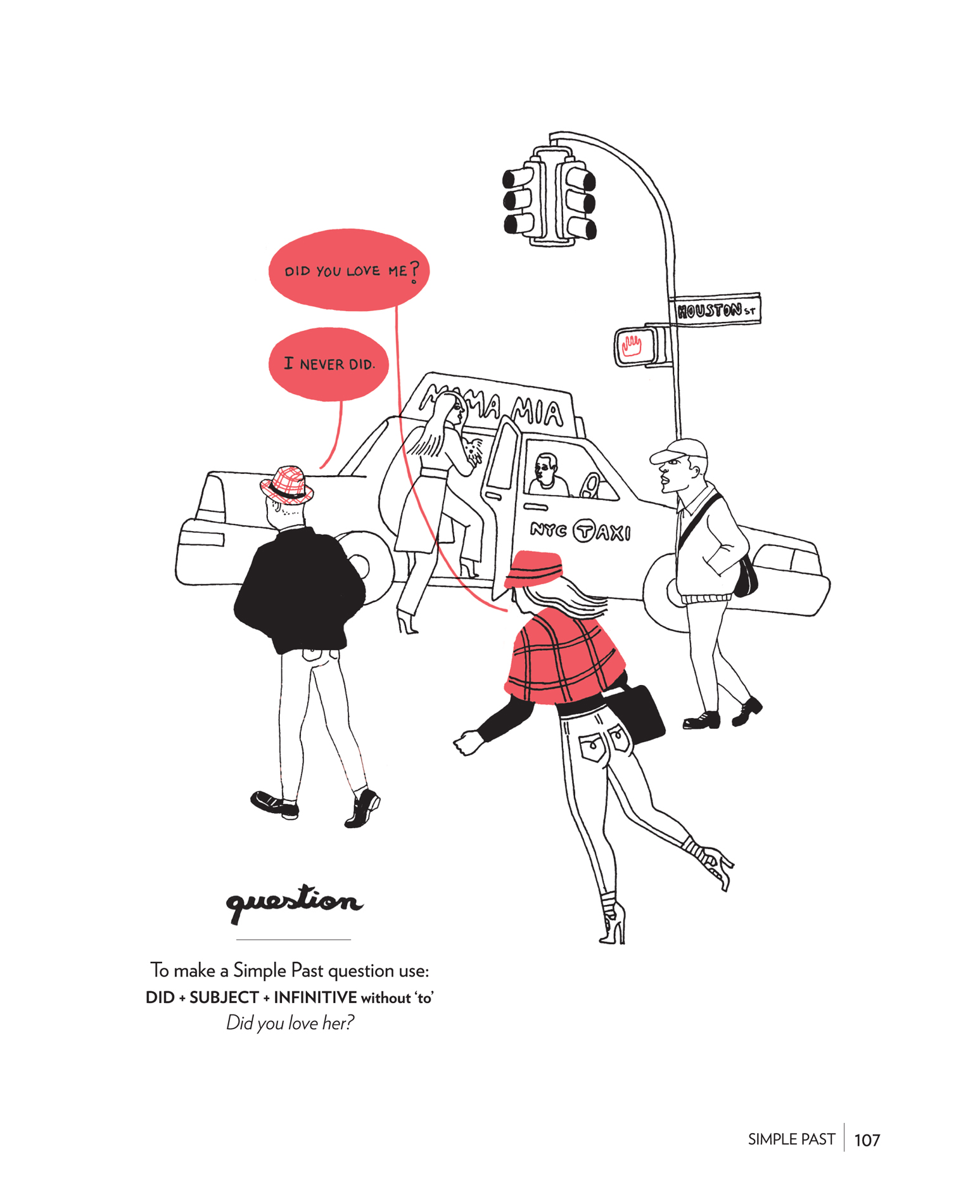
Figure 5.6: NYC 街頭 Did you love me?
不規則動詞(Irregular Verbs)#
There are many irregular verbs in English that do not add ED in the past form. (英文裡有非常多不規則動詞,它們的過去式並不是加 ED,而是要一個一個背起來。)
Figure 5.7: IRREGULAR VERBS 章節開場
書中用一份四欄總表(infinitive / past tense / past participle / meaning)把常用不規則動詞依字母排好。以下完整列出書中收錄的清單。
A–B#
| 原形 | 過去式 | 過去分詞 | 意思 |
|---|---|---|---|
| ARISE | AROSE | ARISEN | emerge(出現、浮現) |
| AWAKE | AWOKE | AWOKEN | stop sleeping(睡醒) |
| BE | WAS | WERE | BEEN | exist(存在、是) |
| BEAT | BEAT | BEATEN | hit repeatedly(反覆擊打) |
| BECOME | BECAME | BECOME | begin to be(變成) |
| BEGIN | BEGAN | BEGUN | start(開始) |
| BEND | BENT | BENT | force something into a curve(彎曲) |
| BET | BET | BET | risk something(打賭) |
| BITE | BIT | BITTEN | use the teeth to cut(咬) |
| BLEED | BLED | BLED | lose blood(流血) |
| BLOW | BLEW | BLOWN | exhale hard(用力吹氣) |
| BREAK | BROKE | BROKEN | separate into pieces(打碎) |
| BRING | BROUGHT | BROUGHT | carry or convey(帶來、攜帶) |
書中為 BEAT 配了一張穿吊帶與蝴蝶結的男士被閃電打中胸口的圖,搭配例句:He has a heart but it doesn’t beat any more.(他還有一顆心,但它已經不再跳動。)並標出 braces(英式吊帶)、suspenders(美式吊帶)、bow tie(蝴蝶結)、storm(暴風雨)、lightning(閃電)等字。
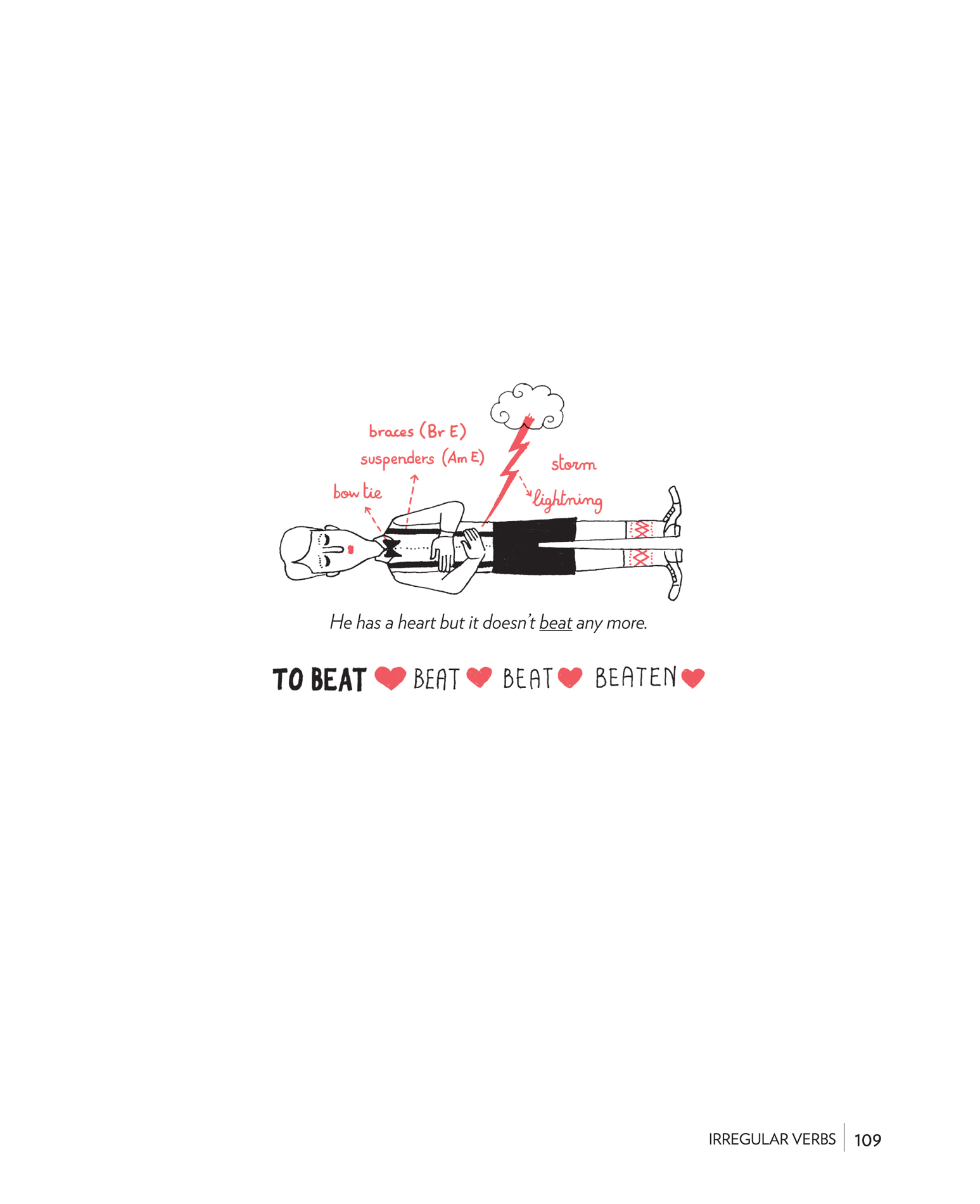
Figure 5.8: BEAT — 被閃電擊中的紳士
B–F(續)#
| 原形 | 過去式 | 過去分詞 | 意思 |
|---|---|---|---|
| BUILD | BUILT | BUILT | construct(建造) |
| BURN | BURNED | BURNT | BURNED | BURNT | be destroyed by fire(燒毀) |
| BURST | BURST | BURST | cause to break by puncture(爆裂) |
| BUY | BOUGHT | BOUGHT | obtain in exchange for payment(購買) |
| CATCH | CAUGHT | CAUGHT | intercept and hold(接住、抓住) |
| CHOOSE | CHOSE | CHOSEN | select(選擇) |
| CLING | CLUNG | CLUNG | hold on tightly(緊抓住) |
| COME | CAME | COME | move towards the speaker(過來) |
| COST | COST | COST | have a price(要價、花費) |
| CREEP | CREPT | CREPT | move slowly(緩慢移動) |
| CUT | CUT | CUT | make an incision(切、割) |
| DEAL | DEALT | DEALT | distribute or sell(分配、買賣) |
| DIG | DUG | DUG | extract earth from the ground(挖土) |
| DIVE | DIVED | DIVED | plunge into water(跳水) |
| DO | DID | DONE | make | perform(做) |
| DRAW | DREW | DRAWN | make a picture with lines(畫畫) |
| DREAM | DREAMED | DREAMT | DREAMED | DREAMT | imagine during sleep(作夢) |
| DRINK | DRANK | DRUNK | the act of swallowing a liquid(喝) |
| DRIVE | DROVE | DRIVEN | operate a motor vehicle(開車) |
| EAT | ATE | EATEN | ingest food(吃) |
| FALL | FELL | FALLEN | move downwards without control(跌落) |
| FEED | FED | FED | give food(餵食) |
| FEEL | FELT | FELT | be aware of a physical sensation(感覺) |
| FIGHT | FOUGHT | FOUGHT | take part in a struggle | argue(打架、爭論) |
| FIND | FOUND | FOUND | discover something(發現) |
書中為 BURST 配了一張頭髮綁絲帶的女士裸露胸部、被吹風機吹爆的圖(標出 tits、nipple);FEED 則畫了一位長髮女子用湯匙吃東西,下方標 FEED FED FED。
F–L#
| 原形 | 過去式 | 過去分詞 | 意思 |
|---|---|---|---|
| FIT | FITTED | FITTED | be the right size or shape(合身、合尺寸) |
| FLEE | FLED | FLED | run away(逃跑) |
| FLING | FLUNG | FLUNG | throw forcefully(用力丟) |
| FLY | FLEW | FLOWN | move through the air(飛) |
| FORBID | FORBADE | FORBIDDEN | refuse to allow(禁止) |
| FORGET | FORGOT | FORGOTTEN | cease remembering(忘記) |
| FORGIVE | FORGAVE | FORGIVEN | stop feeling angry towards someone(原諒) |
| FREEZE | FROZE | FROZEN | turn into ice(結冰) |
| GET | GOT | GOT | come to have | obtain | receive(得到) |
| GIVE | GAVE | GIVEN | transfer something to someone(給) |
| GO | WENT | GONE | move from one place to another(去) |
| GRIND | GROUND | GROUND | reduce to small pieces by crushing(磨碎) |
| GROW | GREW | GROWN | progress to maturity or in size(生長) |
| HANG | HUNG | HUNG | suspend(懸掛) |
| HAVE | HAD | HAD | possess, own or hold(擁有) |
| HEAR | HEARD | HEARD | perceive sound(聽見) |
| HIDE | HID | HIDDEN | put or keep out of sight(藏) |
| HIT | HIT | HIT | come into contact forcefully(擊中) |
| HOLD | HELD | HELD | keep within one’s arms or hands(握住) |
| HURT | HURT | HURT | cause physical pain(傷害) |
| KEEP | KEPT | KEPT | have or retain possession of(保留) |
| KNEEL | KNELT | KNELT | support oneself on one’s knees(跪) |
| KNIT | KNITTED | KNITTED | work wool with needles(編織) |
| KNOW | KNEW | KNOWN | perceive directly(知道) |
| LAY | LAID | LAID | put in position(放置) |
HANG 有兩種變化要分清楚:
- HANG – HUNG – HUNG:把東西「懸掛」起來。
- HANG – HANGED – HANGED:把人「處以絞刑」。
書中用一棵大樹當例子:Little Monkey hanged Thomas while he hung from a tree.(小猴子把 Thomas 吊死,而牠自己則掛在樹上。)
書中還畫了 FORBID(戴領帶男子抽著菸、抱著小男孩說 I forbid you to smoke.)和 KNEEL(長髮女子跪下來和大丹狗親親,Jason kneels to say hello to his dog.)兩格漫畫。
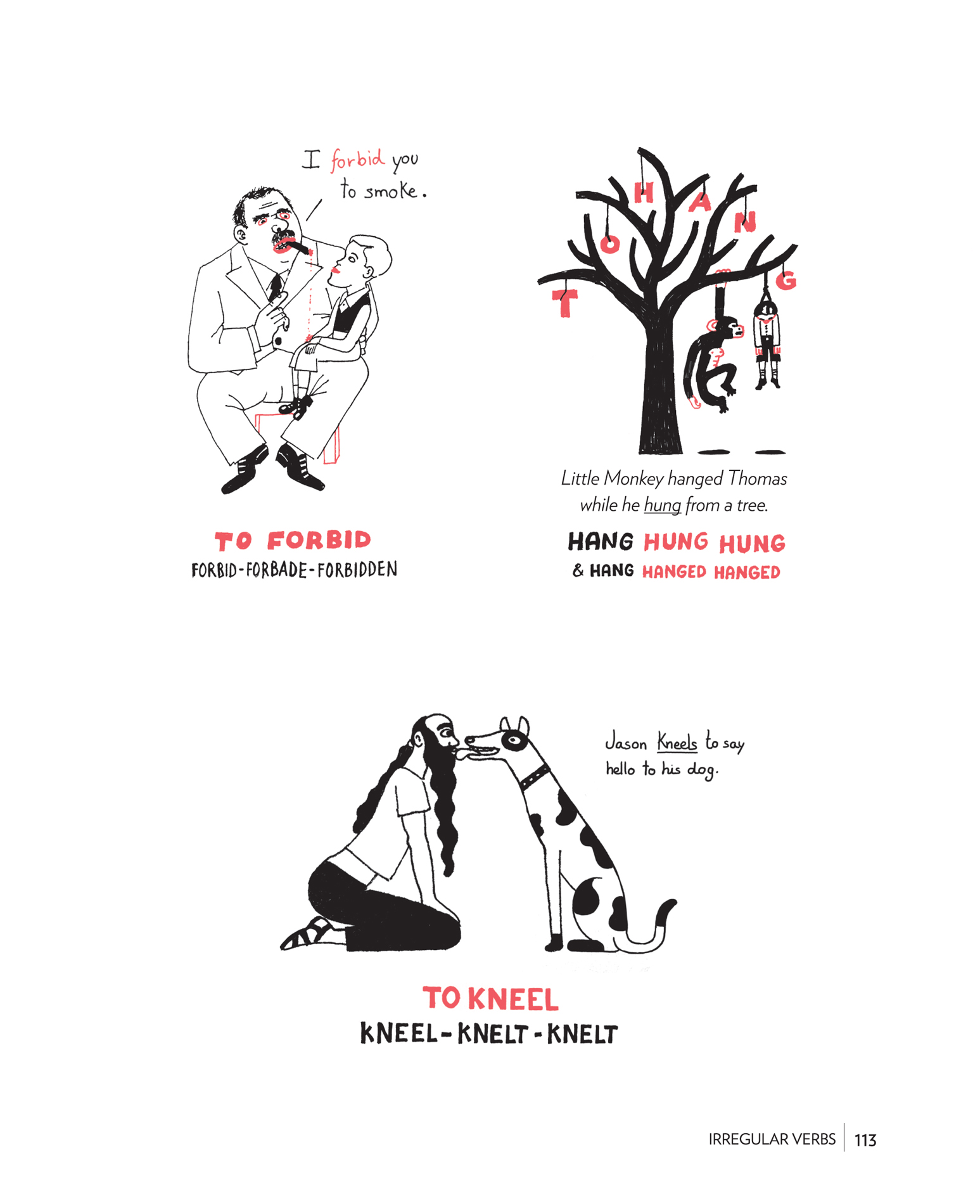
Figure 5.9: FORBID / HANG / KNEEL 三格漫畫
L–S#
| 原形 | 過去式 | 過去分詞 | 意思 |
|---|---|---|---|
| LEAD | LED | LED | show the way by going ahead(領導、帶路) |
| LEAP | LEAPED | LEAPT | LEAPED | LEAPT | jump(跳躍) |
| LEAVE | LEFT | LEFT | go out of or far away from(離開) |
| LEND | LENT | LENT | allow the use of something temporarily(借出) |
| LET | LET | LET | allow(允許、讓) |
| LIE | LAY | LAIN | assume a horizontal position(躺) |
| LIGHT | LIT | LIGHTED | LIT | LIGHTED | illuminate(點亮) |
| LOSE | LOST | LOST | cease to have or retain something(失去) |
| MAKE | MADE | MADE | create | construct(製作) |
| MEAN | MEANT | MEANT | intend to convey | signify(意指) |
| MEET | MET | MET | come into the presence of someone(見面) |
| PAY | PAID | PAID | give money due for goods or services(付錢) |
| PROVE | PROVED | PROVED | PROVEN | demonstrate the truth(證明) |
| PUT | PUT | PUT | place in a specified location(放) |
| QUIT | QUIT | QUIT | stop an activity | leave a job(停止、辭職) |
| READ | READ | READ | grasp the meaning of written characters(閱讀) |
| RIDE | RODE | RIDDEN | travel and control a vehicle or horse(騎) |
| RING | RANG | RUNG | surround | make a bell sound(圍繞、響鈴) |
| RISE | ROSE | RISEN | go up | increase(上升) |
| RUN | RAN | RUN | move fast on foot(跑) |
| SAY | SAID | SAID | express in words(說) |
| SEE | SAW | SEEN | perceive with the eyes(看見) |
| SEEK | SOUGHT | SOUGHT | try to locate | search for(尋找) |
| SELL | SOLD | SOLD | give in exchange for money(賣) |
| SEND | SENT | SENT | cause to be taken to a destination(寄送) |
書中為 LEAD 畫了一個騎在伙伴肩上的男孩帶著幫派前進,旁註 He leads the gang.(他率領這群人。)以及 They are easily led.(他們很容易被帶著走。)。LEND 則畫了一個戴緞帶與項鍊的女士並附上 Mrs Sharp 的小故事:Mrs Sharp borrowed a little thing from Mr Sharp. Mr Sharp didn’t want to lend it to her. She pretended to understand, but she didn’t. When night came and the snores of Mr Sharp got louder, she raised the knife . . . and cut! Then she could sleep soundly.(夏普太太想跟夏普先生借個小東西,他不肯。她假裝理解,其實沒有。等到晚上夏普先生鼾聲變大,她舉起刀子……一刀!從此夜夜好眠。)藉此讓人記住 borrow(借入)和 lend(借出)的差別。
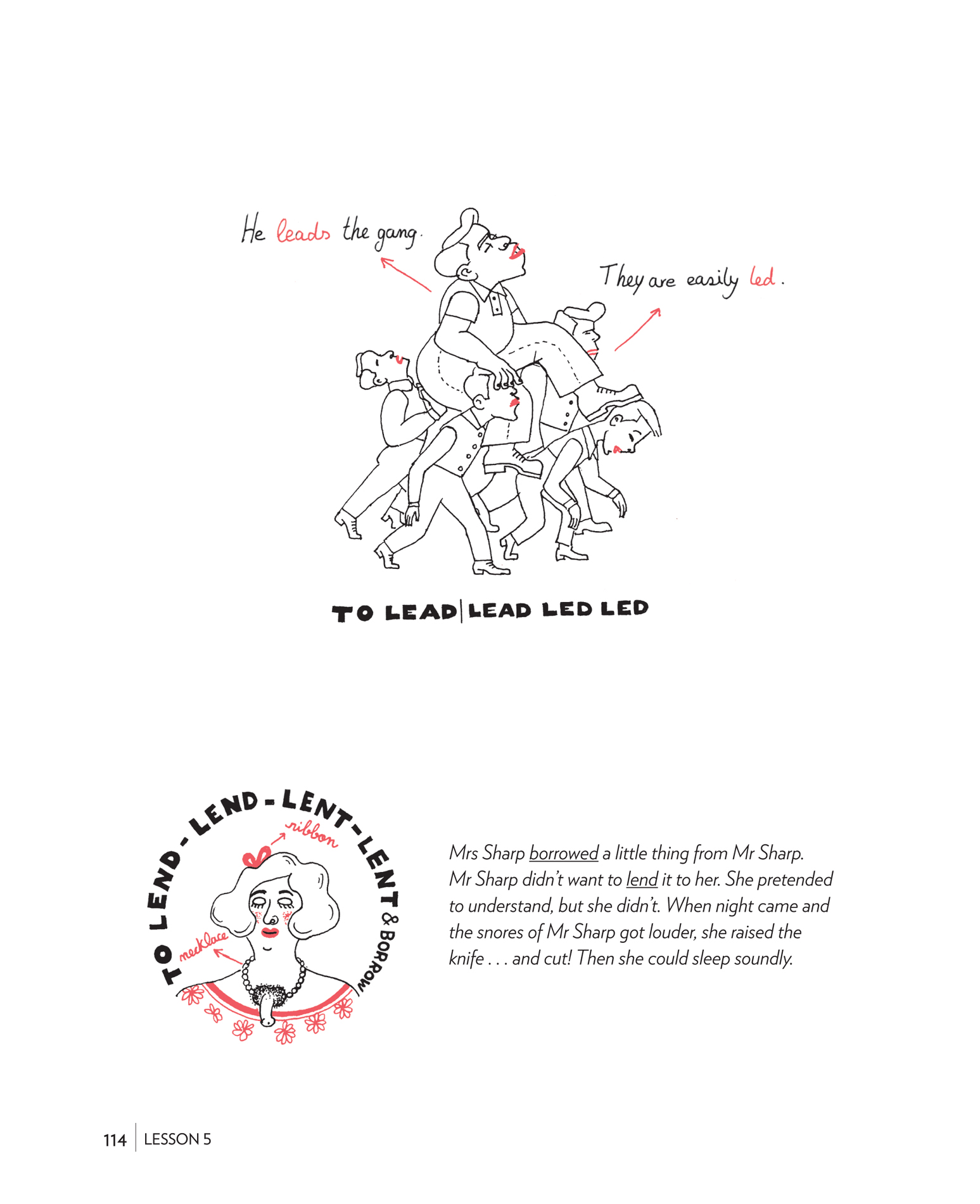
Figure 5.10: LEAD 幫派與 LEND Mrs Sharp 故事
S(續)#
| 原形 | 過去式 | 過去分詞 | 意思 |
|---|---|---|---|
| SET | SET | SET | put in a specified position or state(放置、設定) |
| SEW | SEWED | SEWN | stitch with needle and thread(縫紉) |
| SHAKE | SHOOK | SHAKEN | move with jerky movements(搖晃) |
| SHAVE | SHAVED | SHAVED | SHAVEN | cut hair off with a razor(剃毛) |
| SHINE | SHONE | SHINED | SHONE | SHINED | emit light(發光) |
| SHOOT | SHOT | SHOT | fire a bullet from a weapon(射擊) |
| SHOW | SHOWED | SHOWN | cause or allow to be seen(展示) |
| SHRINK | SHRANK | SHRUNK | SHRUNKEN | become smaller(縮小) |
| SHUT | SHUT | SHUT | move something to block passage(關閉) |
| SING | SANG | SUNG | make musical sounds with the voice(唱歌) |
| SINK | SANK | SUNK | submerge(下沉) |
| SIT | SAT | SAT | rest one’s weight on the buttocks(坐) |
| SLEEP | SLEPT | SLEPT | rest one’s body and mind(睡覺) |
| SLIDE | SLID | SLID | move smoothly over a surface(滑動) |
| SPEAK | SPOKE | SPOKEN | talk(說話) |
| SPEED | SPED | SPEEDED | SPED | SPEEDED | move quickly(加速) |
| SPEND | SPENT | SPENT | pay out money(花費) |
| SPILL | SPILLED | SPILT | SPILLED | SPILT | allow a liquid to fall out of its container(潑灑) |
| SPIN | SPUN | SPUN | rotate quickly(旋轉) |
| SPIT | SPAT | SPAT | eject from the mouth(吐) |
| SPLIT | SPLIT | SPLIT | divide into parts(分開) |
| SPREAD | SPREAD | SPREAD | open wider | extend(散開、擴展) |
| SPRING | SPRANG | SPRUNG | move upwards or forwards(彈跳) |
| STAND | STOOD | STOOD | maintain an upright position(站立) |
| STEAL | STOLE | STOLEN | take without permission or right(偷) |
書中為 SEW 配了一張站姿的人體圖(縫線清楚可見)並寫道:Mr Smith sewed half of his pretty neighbour’s body and half of his nice butcher’s body together. Now he has the perfect wife. Or does he have the perfect husband?(史密斯先生把漂亮鄰居的半邊身體和肉販的半邊身體縫起來,現在他有了完美的太太。或者他有了完美的先生?)
S–W(續)#
| 原形 | 過去式 | 過去分詞 | 意思 |
|---|---|---|---|
| STICK | STUCK | STUCK | pierce, puncture(刺、黏住) |
| STING | STUNG | STUNG | prick painfully(叮、螫) |
| STINK | STANK | STUNK | emit bad smell(發出臭味) |
| STRIKE | STRUCK | STRUCK | hit with the hand or a weapon(打擊) |
| SWEAR | SWORE | SWORN | make a solemn statement or promise(發誓) |
| SWEEP | SWEPT | SWEPT | clean with a broom(掃除) |
| SWIM | SWAM | SWUM | move through water(游泳) |
| SWING | SWUNG | SWUNG | move back and forth suspended(搖擺) |
| TAKE | TOOK | TAKEN | grasp with the hands | consume(拿、服用) |
| TEACH | TAUGHT | TAUGHT | show or explain how to do something(教) |
| TEAR | TORE | TORN | pull apart by force(撕裂) |
| TELL | TOLD | TOLD | communicate by speech or writing(告訴) |
| THINK | THOUGHT | THOUGHT | formulate in the mind(思考) |
| THROW | THREW | THROWN | propel through the air(投擲) |
| TREAD | TROD | TRODDEN | step on(踩踏) |
| UNDERSTAND | UNDERSTOOD | UNDERSTOOD | comprehend meaning(理解) |
| UPSET | UPSET | UPSET | make someone distressed(使心煩) |
| WAKE UP | WOKE UP | WOKEN UP | emerge from a state of sleep(醒來) |
| WEAR | WORE | WORN | carry or have on one’s body(穿戴) |
| WEAVE | WOVE | WEAVED | WOVEN | make by interlacing threads(編織) |
| WEEP | WEPT | WEPT | cry(哭泣) |
| WIN | WON | WON | be successful or victorious(贏) |
| WITHDRAW | WITHDREW | WITHDRAWN | take back or away(撤回、提領) |
| WRING | WRUNG | WRUNG | twist to extract liquid(擰、絞) |
| WRITE | WROTE | WRITTEN | form letters on a surface(書寫) |
書中最後一頁配了四格漫畫式插圖:STICK(女子被多把刀刺穿頭部,STICK · STUCK · STUCK)、STING(手指被一隻笑著的小蟲叮了一下,STING – STUNG – STUNG)、SWEEP(男子拿著掃把掃地,配旁白 Who says that men don’t clean? — 誰說男人不打掃?)以及 WRING(兩隻手把一隻小鳥擰出血滴,旁註 To extract liquid, wring tightly. — 要擠出液體,就用力擰。)
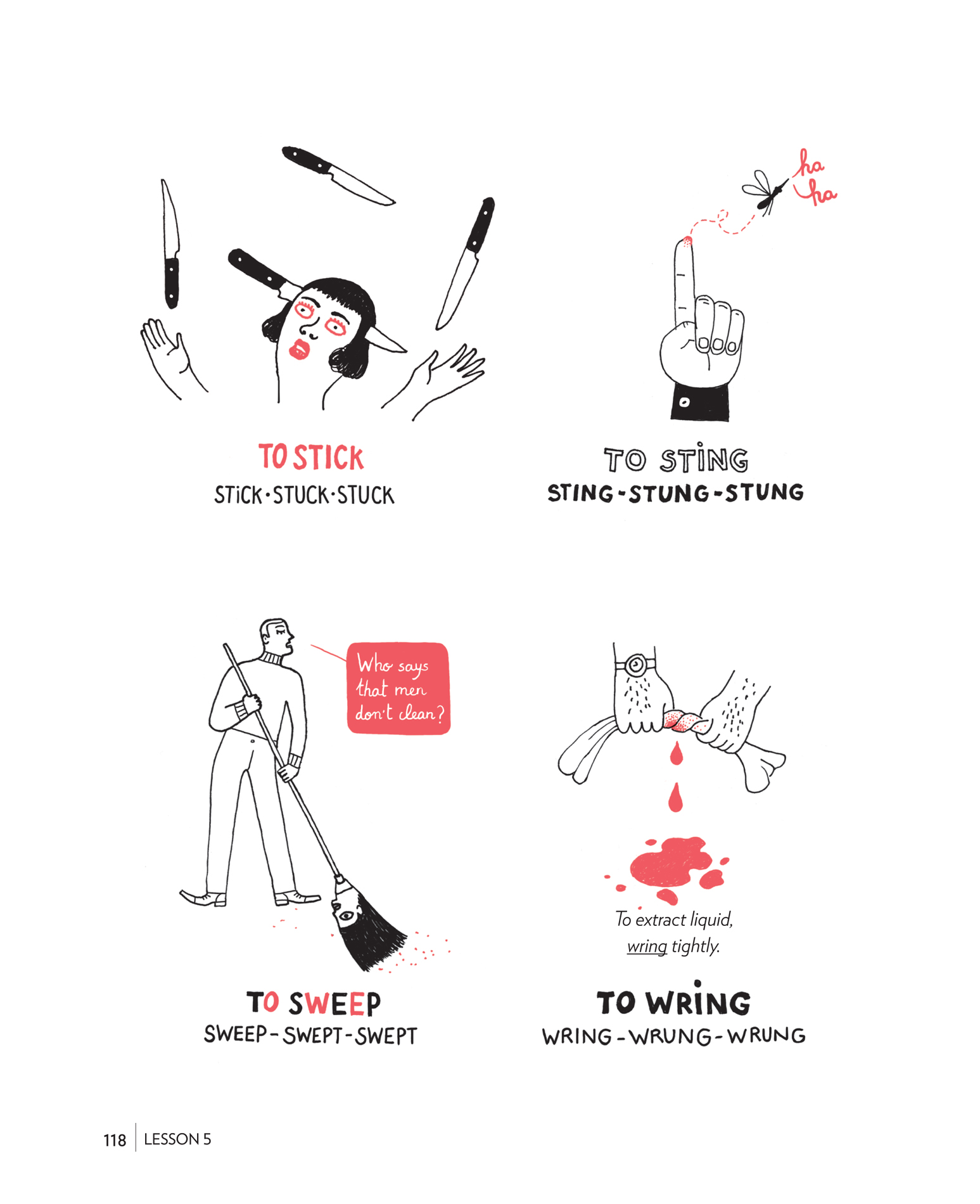
Figure 5.11: STICK / STING / SWEEP / WRING 四格漫畫
不規則動詞表很長,不需要一次背完。建議先掌握最常用的:be、have、do、go、come、see、say、make、take、get、give、know、think、find、tell,再慢慢擴充。書中的圖文搭配就是設計給人「看著畫面記動詞」用的。